
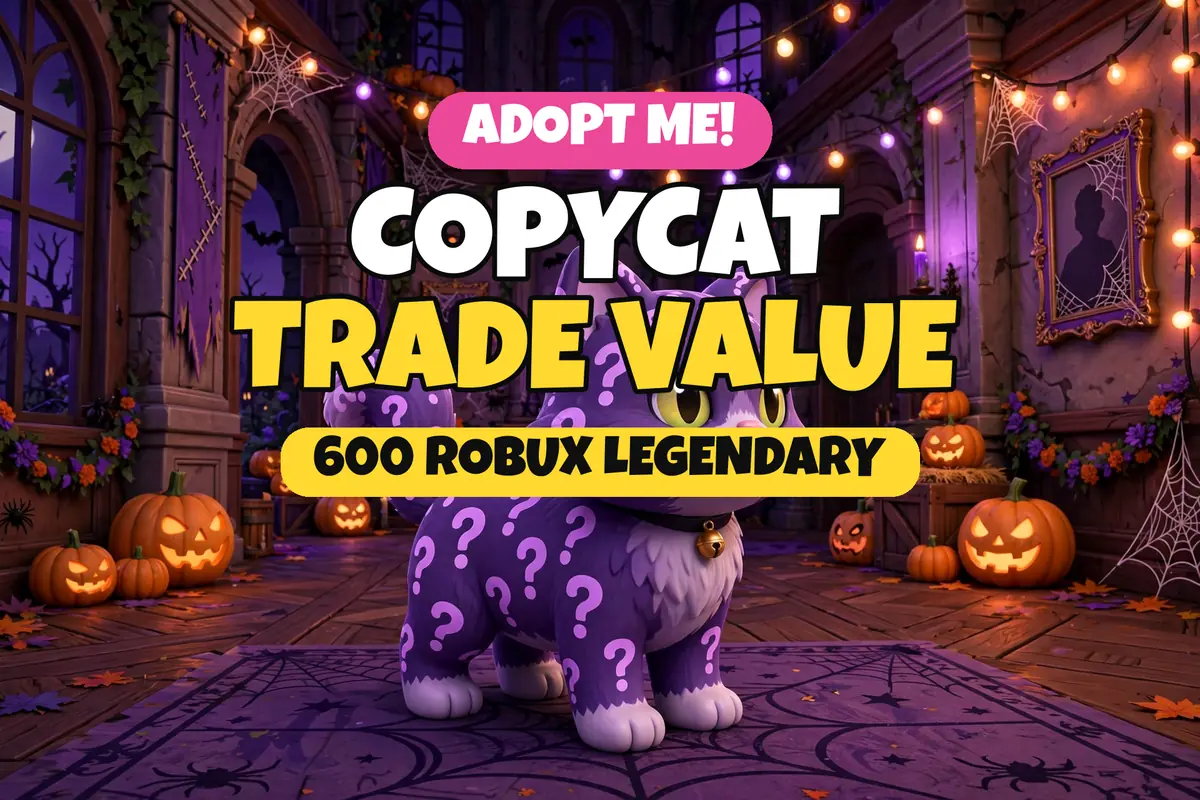

For the first week of its life, the Copycat had a price tag but no trade value. You could buy it in the Manor for 600 Robux, yet no tracker would tell you what it was actually worth in a trade, because there simply had not been enough completed trades to measure. That changed this week. Community trackers have now listed the Copycat with a real number, and the first confirmed trade behind that number is on the public record.
This copycat trade value update answers one question with everything the market has shown so far: what is the Copycat actually worth in trades, where did that number come from, and what should you do with the information.
The Number on the Board
The Copycat is now tracked at 5.5 RP on the community value scale. RP stands for the community’s shared trading unit, and the number means traders are treating one regular Copycat as worth roughly five and a half units of that scale in real offers. That figure is the copycat trade value now on the board.
A few things matter about how to read that number. First, no official Adopt Me value list exists. The game’s own support pages confirm there is no official trading value system and no endorsed value website, so every number you see on any tracker is a community estimate, not a price set by the developers. Trackers build these estimates from completed trades, active offers, and demand signals across trading servers, then revise them as new evidence arrives. That is exactly what happened here: enough Copycat trades completed for the trackers to stop guessing and start listing.
Second, the number moves. A tracked value reflects recent market behavior, not a guarantee that your next trade will land on it. Treat it as the starting point of a negotiation, the figure both sides can point at, and then let the actual offers decide the rest. If you want to view the value list, please visit our live Adopt Me value list, where the Copycat’s number refreshes as the trackers revise it.
The Trade That Put It on the Board
Numbers on a tracker only mean something if real trades back them up, and the Copycat has one that is unusually clean. On the Adopt Me Trading Values change log, the Shrew’s entry for October 21 notes that a Shrew recently traded straight across for a Copycat, and the Shrew’s own tracked value ticked upward on the same update.
That single trade tells you three useful things. It tells you the Copycat is being accepted at roughly the Shrew’s level, which is a mid-tier legendary-adjacent range, not the premium tier its 600 Robux price might suggest. It tells you traders on both sides considered the swap fair enough to confirm, which is stronger evidence than any asking price in a trading server. And it tells you the market is already treating the Copycat as a normal, liquid pet rather than a novelty nobody will touch, because straight-across swaps only happen when both pets have recognizable value.
One trade is still one trade, though. The honest way to use it is as an anchor: the Copycat changes hands in the same neighborhood as pets tracked near 5 RP. Your specific trade can land above or below that depending on demand, potion status, and how badly the other person wants a transforming cat. If you want to see which pets are rising and falling around it, take a look at our live value history tracker.
600 Robux, Translated Into Trade Language
Here is the comparison every Robux buyer should make. The Copycat costs 600 Robux in the Manor shop, and the market values it at 5.5 RP. The Jester Dragon, the week 1 Halloween legendary, costs 1,000 Robux and is tracked at 8 RP.
Read that in words rather than arithmetic. The Jester Dragon costs two-thirds more Robux than the Copycat, yet its tracked trade value sits only about half again above the Copycat’s. In plain terms, the cheaper pet buys you nearly as much tracked trade value per Robux as the expensive one. That is not a small detail. It means the Copycat, for all the skepticism about a 600 Robux cat, is converting its shop price into trade value at a healthier rate than the flagship week 1 pet.
There is a second lesson in the Jester Dragon’s trajectory. The same tracker that listed the Copycat just lowered the Jester Dragon from 9.2 to 8 RP, noting that owners are struggling to get the offers the old number promised, including failing to land a Phantom Dragon after an hour in the Trading Hub. New Halloween pets lose their launch premium fast once the novelty fades and fresh supply keeps arriving. The Copycat’s first tracked number was set after that pattern had already started, which makes it a more honest figure than a day-one estimate would have been. If you want to read about the 1,000 Robux week 1 pet, take a look at our Jester Dragon worth-it breakdown.
Two Prices, One Pet
Every limited pet in Adopt Me really has two prices, and the Copycat shows the split clearly. The shop price is fixed: 600 Robux, same for everyone, no negotiation. The trade value floats: it rises and falls with demand, supply, and hype, and right now it sits at 5.5 RP.

The floating price is where confusion starts, because the loudest numbers around the Copycat are not the regular-pet numbers. YouTube is full of Mega Neon Copycat trades pulling big overpays, with creators showing off the first megas and the wild offers they attracted. Those videos are real, but they describe a different market. A Mega Neon costs sixteen regular Copycats plus the enormous aging time to grow them, and its buyer pool is collectors and flex traders, not ordinary players swapping one pet for another. If you own a regular Copycat, the mega circus does not apply to you, and pricing your regular pet off a mega trade is the fastest way to sit in a trading server all afternoon with no offers.
The regular market is quieter and more honest. Pets near 5 RP change hands for other pets in the same band, sometimes with small adds on one side. That is the market you are actually in. If you want to check whether an offer is a win or a loss before you confirm, please visit our trade value calculator and put both sides in.
What Pushes the Number Up (and What Drags It Down)
Tracked values move for reasons, and the Copycat has a clear set of forces on each side. Start with the pushes.
The Polymorph ability is the obvious one. The official Halloween notes describe the Copycat as a Manor pet with a built-in random Polymorph ability that transforms it into any pet in the game, working like the Polymorph Potion, with the notes themselves teasing the dream of it becoming a Bat Dragon. No other pet in the game does this on its own. Novelty mechanics have a real, measurable effect on demand, because traders pay for the story as well as the stats, and “the cat that can become anything” is a story every trading server understands in one sentence.
Seasonality is the second push. The Halloween event runs from October 3 to October 31, and event pets always trade best while the event is live and visible. Every player walking past the Manor sees the Copycat. Every Halloween video features it. Attention is a form of demand, and the Copycat has more of it right now than at any point in its future.
The third push is scarcity of a specific kind: Robux pets have a natural supply cap that Candy Corn pets do not. Grinding 600 Robux worth of purchases is a real-money decision for most players, so the total number of Copycats entering the game is far smaller than the number of Candy Corn pets like the Stitches or the Boohoo. Smaller supply with steady demand is the classic recipe for a value that holds.
Now the drags, because they are just as real. The biggest one is that the supply window is still open. Anyone can still walk into the Manor and buy a fresh Copycat for 600 Robux until the event ends, which puts a soft ceiling on the trade value: why overpay in a trade when the shop sells it at face value. The second drag is the new-pet discount cycle. Week 1 pets like the Jester Dragon are already sliding as their launch hype fades, and the Copycat will face the same gravity once week 4 content arrives and attention moves on. The third drag is expectation mismatch. Some buyers paid 600 Robux expecting a premium-tier trade asset and will be disappointed to find it valued in the mid tier, and disappointed owners are impatient sellers, which pushes accepted offers down.
Net it out and the picture is balanced: genuine demand drivers against genuine downward pressure, which is exactly what a first tracked value of 5.5 RP looks like. It is neither a hype number nor a panic number. If you want to check how much demand a pet has behind its number, take a look at our demand checker.
Reading the Number Like a Trader
Knowing the copycat trade value is only useful if you can turn it into decisions. Here is how traders actually use a number like this.
First, build your swap list from the neighborhood, not from wishful thinking. Pets tracked within a point or so of the Copycat are your realistic straight-swap candidates, and the Shrew trade is your proof that swaps in this band close. Start your search there instead of pitching the Copycat at pets two tiers up and collecting rejections.
Second, price the adds, not just the pets. Most Copycat trades will not be straight swaps. They will be the Copycat plus a small add for something slightly above it, or the Copycat for something slightly below it plus a sweetener. Small adds are where most traders lose value without noticing, because they throw in a ride potion or a mid-tier pet to “make it fair” without checking what the add is worth. Run the whole trade, both sides, through a calculator before you confirm.
Third, separate the pet from the potions. A Copycat with Fly or Ride applied is a different asset from a clean one, and the gap matters more than most players expect. Never apply a potion to “increase the value” before checking what potion-less and potion-carrying Copycats are actually getting. Collectors often pay for the choice, and a potion you cannot remove can narrow your buyer pool.
Fourth, watch demand, not just value. A pet can hold its tracked value while becoming harder to trade, which is what the Jester Dragon’s notes describe: the number said 9.2, but owners could not get the offers. If Copycat offers start taking longer to find or keep coming in below the tracked number, the market is telling you something the number has not caught up with yet. If you want to learn the full method for reading these signals, take a look at our 5-step guide to checking values.
The October 31 Cutoff
The Halloween event ends on October 31, and when it does, the Manor shop closes on the Copycat. No more fresh supply enters the game through the shop. That is the single most important date on the Copycat’s calendar, because everything about its value after that point is decided by the existing supply meeting whatever demand remains.
What mechanically changes: the soft ceiling from the shop price disappears. During the event, no trade can reasonably exceed what the shop charges, because the shop is always an alternative. After the event, that anchor is gone, and the value floats purely on what traders will pay. In past event cycles, this is the moment limited pets either find their level or drift, and the direction depends on the balance this article has been describing: Polymorph novelty and Robux-pet scarcity pulling up, fading attention pulling down.
What does not change: the Copycat does not become rare overnight. Plenty of them were bought during the event, and impatient sellers will keep listing them. Anyone telling you the value automatically climbs after Halloween is selling you a story, not an analysis. The honest version is that the cutoff removes the ceiling and lets the market decide, and the market’s decision will show up in the tracked number within a week or two. Keep watching the live number rather than predicting it.
One practical note: if you are buying with Robux, buy before the cutoff, because after it the only path is trading. If you are trading, the days right around the cutoff are the most volatile, with the most impatient sellers and the most opportunistic buyers, so do not rush a big decision in that window. If you want the full event pet lineup and their prices, take a look at our Halloween 2026 pets guide.
Three Mistakes Copycat Owners Make Right Now
Mistake one: treating the tracked value as a promise. The trackers list the Copycat at 5.5 RP, and then owners walk into trading servers demanding exactly that in every trade. Tracked values describe what the market has been doing, not what your next trade partner must accept. The number is your opening reference, not your closing argument. Traders who anchor hard on the number waste hours; traders who use it as a starting point close deals.
Mistake two: pricing a regular off mega hype. Watching a Mega Neon Copycat pull a huge overpay on YouTube and then expecting similar excitement for your single regular pet is a category error. Megas are collector items with sixteen pets of cost baked in. Regulars are utility trades. They are different markets with different buyers, and the regular market pays Shrew-level prices, as the actual trade record shows.
Mistake three: assuming the Polymorph ability guarantees growth. The transforming trick is genuinely unique, and it is a real demand driver, but mechanics do not override supply and demand arithmetic. A fun ability on a pet that thousands of players bought is still a pet that thousands of players can list. The ability supports the value; it does not multiply it. Trade the pet you have, not the pet the ability makes you imagine.
The Bottom Line
The copycat trade value is finally on the board: 5.5 RP, backed by a real Shrew-for-Copycat trade on the public record and set after the launch hype had already started fading, which makes it one of the more honest first numbers a new pet has gotten. It converts its 600 Robux shop price into trade value at a healthier rate than the 1,000 Robux Jester Dragon manages, it sits in a liquid mid-tier band where straight swaps actually close, and its unique Polymorph ability gives it a demand story no other pet can copy.
None of that makes it a guaranteed winner. The supply window is still open until October 31, week 1 pets are already sliding, and the tracked number is a starting point for negotiation, not a promise. Use the number the way traders do: as the anchor for realistic swaps, checked against a calculator, with an eye on demand. If you missed our original breakdown of the pet itself, take a look at our Copycat worth-it guide.
FAQs
Every question below comes from what players are actually asking about the copycat trade value. Short answer first, then the detail.
What is the Copycat worth in Adopt Me?
The Copycat is tracked at 5.5 RP on the community value scale. That figure comes from community trackers that revised the pet from untracked to listed once enough completed trades existed to measure. Remember that this is a community estimate, not an official price, because Adopt Me has no official value list. Use it as your starting reference in negotiations and confirm real offers before trading.
Is the Copycat worth more than the Jester Dragon?
No. The Jester Dragon is tracked at 8 RP, which sits about half again above the Copycat’s 5.5 RP. The interesting part is the shop prices: the Jester Dragon costs 1,000 Robux while the Copycat costs 600, so the cheaper pet converts its Robux price into trade value at the healthier rate of the two. Higher value and better value for money are different questions, and the two pets give different answers.
What can you get for a Copycat in a trade?
Realistically, pets in the same tracked band. The cleanest public evidence is a Shrew trading straight across for a Copycat, and the Shrew is tracked at 5 RP. Aim your offers at pets within about a point of the Copycat’s 5.5 RP for straight swaps, and expect small adds on one side when the pets are not exactly level. Pitching two tiers up usually just collects rejections.
Is a Shrew a fair trade for a Copycat?
Based on the public trade record, yes, it is about as fair as trades get. The Adopt Me Trading Values change log records a Shrew trading for a Copycat, and the Shrew’s own tracked value ticked upward on the same update. A straight swap at that level needed no adds on either side, which is the market’s way of saying the two pets sit in the same band. Individual trades can still vary with potion status and demand.
Will the Copycat’s value go up after Halloween ends?
Nobody can promise that, and you should distrust anyone who does. What is factual: the Manor shop stops selling the Copycat when the event ends on October 31, so no fresh supply enters through the shop after that. That removes the shop-price ceiling and lets the market decide purely on supply and demand. Whether the number rises depends on whether the Polymorph novelty and Robux-pet scarcity outweigh fading attention. Watch the tracked number in the week after the cutoff instead of predicting it.
Why did the Copycat have no trade value before?
Trackers only list a pet once enough completed trades exist to estimate from, and for its first week the Copycat simply had not traded enough. New pets go through this gap between release and first listing every time. The value appeared once real trades, including the documented Shrew swap, gave the trackers evidence to work with. A pet with no tracked value is not worthless; it is just unmeasured.
Does the Copycat’s Polymorph ability raise its trade value?
It supports the value rather than multiplying it. The built-in random Polymorph ability is unique: the official Halloween notes describe it transforming the Copycat into any pet in the game, like the Polymorph Potion. That novelty is a genuine demand driver, because traders pay for the story as well as the stats. But mechanics do not override supply arithmetic, and thousands of players bought this pet. Treat the ability as a reason demand stays healthy, not as a guarantee the number climbs.
Is a Neon Copycat worth four regular Copycats?
Not exactly, and this is true across most of the game. Making a neon costs four full-grown regulars plus significant aging time, and an analysis of 783 pets with both regular and neon values found the median neon trades at about 1.34 times the four-regular cost, with 93 percent of pets gaining from the merge. But that is a median, and new event pets often behave differently from the median while supply is fresh. Check the Copycat’s actual neon listings rather than assuming the formula, and never merge four without confirming the neon market first.
Should I trade my Copycat now or wait until after Halloween?
It depends on what you want. Trading now means dealing in a liquid market where the tracked value of 5.5 RP is fresh and both sides can reference it, but you are also competing with every other owner listing before the cutoff. Waiting until after October 31 removes the shop-price ceiling, which can help, but it also means trading into thinner attention as the event ends. If you have a good offer at the tracked level now, there is no strong reason to gamble on later.
Is the Copycat a good pet for trading profit?
It is a reasonable trading pet, not a profit machine. The tracked value of 5.5 RP sits in a liquid band where swaps actually close, which is more than many new pets manage. But profit needs a rising value, and the Copycat faces real downward pressure: the supply window is still open, week 1 pets are already sliding, and post-event attention always fades. Buying at 600 Robux to flip for profit is speculation, not a plan. Trading it at its tracked level for pets you actually want is the sensible play.
Can you trust the Copycat’s listed value?
You can trust it as a community estimate and distrust it as a guarantee, both at once. The number comes from trackers that watch real trades and revise openly, and the Shrew swap behind it is on the public record. But Adopt Me’s own support pages warn that third-party values can be unreliable, react at different speeds, and never bind the other side of your trade. Use the tracked value to open negotiations and a trade calculator to close them, and you will be using it correctly.
What is the difference between the Copycat’s shop price and its trade value?
The shop price is fixed and official: 600 Robux in the Manor, set by the developers, identical for every buyer. The trade value is floating and unofficial: 5.5 RP, set by community trackers from observed trades, different in effect from trade to trade. One is what you pay the game; the other is what players will give you for the pet. New traders confuse the two constantly, and the confusion costs them. The shop price is a fact; the trade value is an estimate.
Is the Copycat still available to buy?
Yes, while the Halloween event is live. The Copycat is sold in the Manor for 600 Robux, and the event runs from October 3 to October 31. After the event ends, the shop listing goes away and trading becomes the only way to get one. If you are spending Robux rather than trading, buy before the cutoff.
Do Fly or Ride potions change the Copycat’s value?
They change what it is worth to specific buyers, which is not the same as raising its tracked value cleanly. A potion-carrying Copycat is a different asset from a clean one: some buyers pay extra for the ability, while collectors often prefer untouched pets so they can choose their own potions. Never apply a potion to “increase the value” without first checking what potion-carrying Copycats are actually getting in trades. An irreversible potion on a narrowing buyer pool can cost you more than it gains.
Will the Copycat return after Halloween 2026?
Nothing official says it will. The Copycat is a Halloween 2026 event pet, and event pets leave the shop when their event ends, which is October 31 here. Developers sometimes bring pets back for anniversaries or throwback events, but there is no announcement of any return, and assuming one is how traders talk themselves into overpaying. Treat it as gone after the cutoff unless official notes say otherwise.
